Lockdown Systems @ The Global Gathering 2026
In September 2026, Team Community ran it’s annual Global Gathering conference that brings together groups from around the world working on the most urgent technology-related challenges affecting human rights, social justice, civil society, and journalism at the local, regional and global levels.
Lockdown Systems collective members facilitated a circle discussion titled Clawing Back Your Data in the Age of Social Surveillance. Attendees discussed what it means to participate in social media and online networks in 2026 and explored questions such as:
- Under what circumstances is sharing information on the social (and non-social) web important?
- What does deletion mean in a digital context, and when is it critical?
- What kind of data/information do you want to keep safe and from who?
- What is clawing back data in the age of AI and as tech policy evolves?
We examined what it means to back up your data, and the power it holds when Big Tech platforms seek to commodify it. We also discussed that those with intent to harm use our publicly accessible data to generate "new" fabricated data using AI models, in order to shape, edit, or erase narratives from critical voices.
From the discussion – where a majority of attendees were femme/women presenting, along with other marginalized identities like race/ethnicity and sexuality – the main concerns were understanding who has or can get access to your data, and what they can do with it in order to harm you and twist a narrative. The attendees spoke of the increasing worry about media data such as photos and videos and the pressure of being present on platforms known to be harmful, because being there is a necessity for their journalism, activism or work.
Many attendees admitted to being less informed than they would like to be about the technical aspects of social platforms. Questions such as, "How long does a post need to be online before it’s ‘stored’ elsewhere out of my control?" And, "Does it really cease to exist when I delete my own posts and data?" People felt like questions around how deletion services actually work and what methods they employ in order to consistently find relevant information to delete are opaque on purpose. Here, open source tools and organizations were preferred, but also they raised concerns about how safe these tools themselves are from attack and continued existence. People want to rely on systems made by real people that care about the ownership of data, and they also want to know that they’ll be around to help for as long as possible.
In contrast, attendees also spoke about how important it is to their academic and community research to find people, collectives, and organizations posting openly about subjects that are unfortunately controversial. Things like feminism around the world, what the real ordinary lives of people are like under repressive governments, and when people post counter-narratives of their lives. The attendees understood this complex contradiction between the want to own and do what they want with their own data, but also knowing the value of publicly accessible information from others like them.
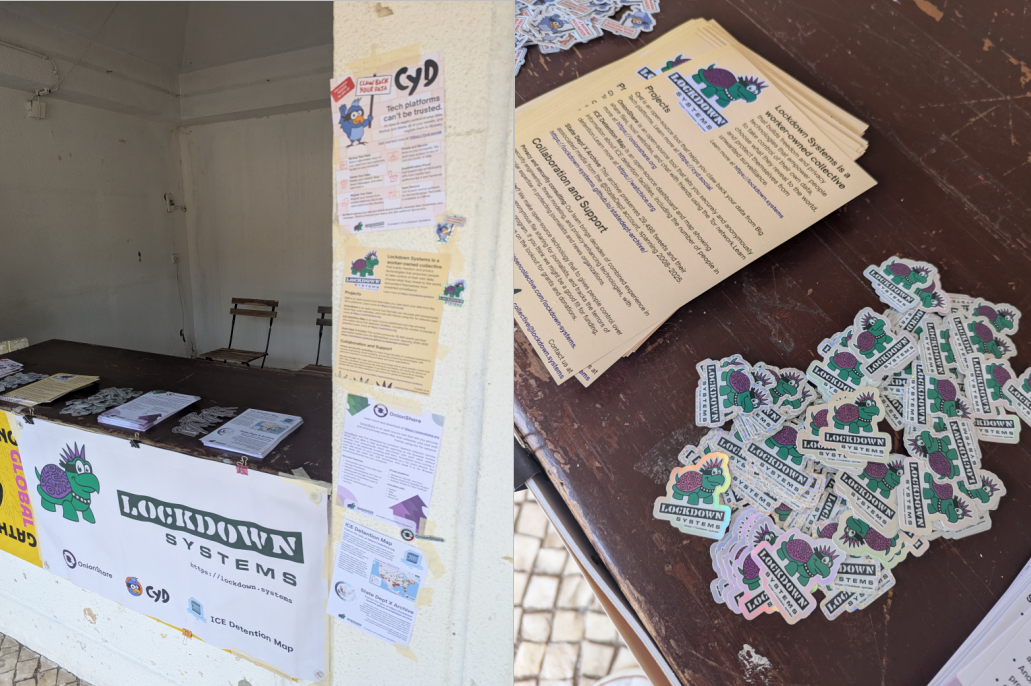
Finally, we had a booth where we could speak to the technology that Lockdown Systems maintains. We spoke to attendees about OnionShare, ICE Detention Map, StateDept X Archive, and Cyd. The folks that passed by our booth asked questions and chatted about our tools and many expressed the desire for us to offer training on how best to use the tools we maintain, which we are discussing as a collective.
Would you like to see Lockdown Systems offer training on using the tools we maintain?
You can message us on Mastodon or Bluesky to let us know or drop us an email on collective@lockdown.systems.